By Robert Yanal
Plato, according to Diogenes Laertius, “was about to compete for the prize with a tragedy, when he listened to Socrates in front of the theatre of Dionysus, and then consigned his poems to the flames, with the words: Come hither, O fire-god, Plato now has need of thee.”
Diogenes’ story may be true or not. In either case, Plato was a dazzlingly good writer.
Plato had the dramatic gifts of a Sophocles or Euripides, but he decided to exploit them in a different literary form: the logos Sokratikos, or ‘conversation with Socrates’. – Charles Kahn, Plato and the Socratic Dialogue.
Apology
In Plato’s Apology, Socrates is given two primary motives for his lifelong work of examining other people.
- The Oracle at Delphi has said that no one is wiser than Socrates, and Socrates takes this as a riddle and tries to refute the Oracle to discover what the god really meant.
- Socrates tells his jury that he is a gadfly, arousing the citizenry of Athens from its sleep by examining them, thereby benefitting the city.
Both cannot be Socrates’ primary motives. Either Socrates aims at refuting the oracle, and by the way benefits the city; or he aims at benefitting the city, and by the way refutes the oracle.
The oracle story itself is queer. A friend of Socrates, Chaerephon, takes it on himself to go to Delphi (180 km northwest of Athens) to ask the Oracle whether anyone is wiser than Socrates.
My theory is that the Oracle story is Plato’s literary invention, created to set Socrates up as a tragic hero.
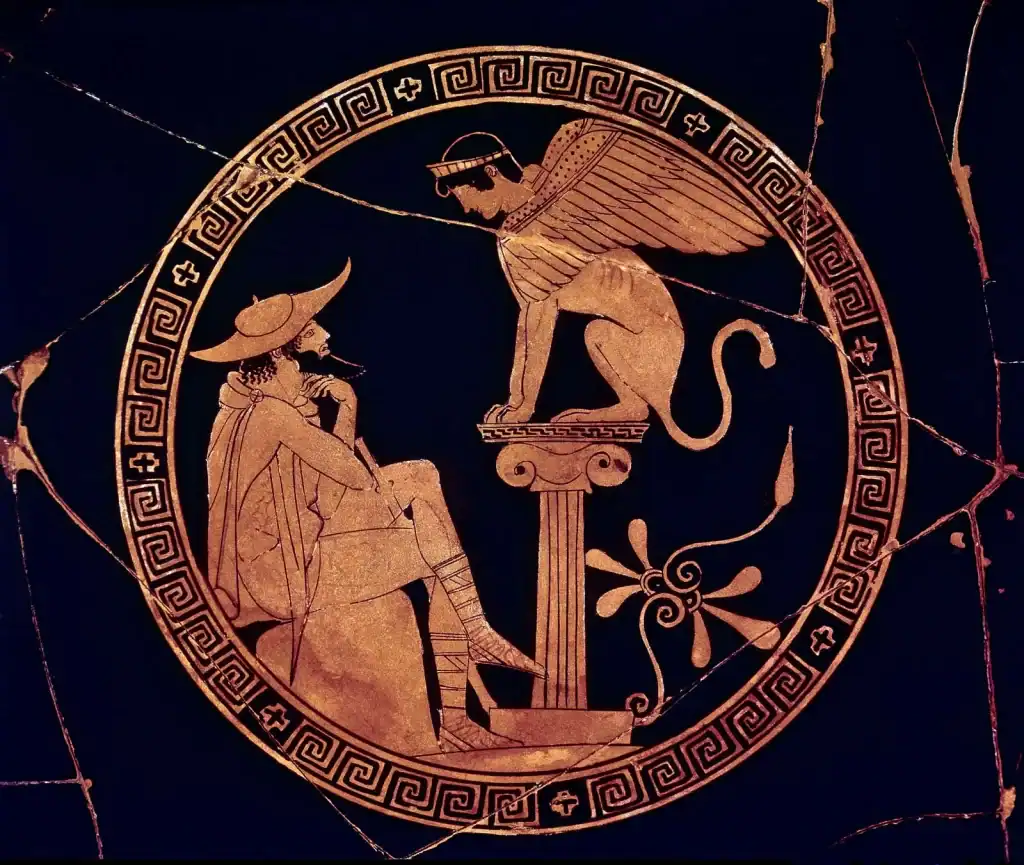
Aristotle in his Poetics, defines the tragedy in terms of its plot: a noble hero because he is flawed brings about his downfall. Aristotle singled out Oedipus for its recognition scene. Plato establishes a narrative for Socrates in the Apology that matches the actions of Oedipus.
Sophocles, Oedipus | Plato, Apology |
|
|
|
|
|
|
|
|
|
|
|
|
The pattern of attempting to avoid the prophetic event and failing is repeated in myth. It was prophesied that Achilles would die young. Thetis, his mother, dipped him in the River Styx to make him invulnerable, but held him by his heel. Apollo directs the Trojan prince Paris to shoot Achilles in the heel. Perseus was prophesied to kill his grandfather, King Acrisius of Argos. To prevent this, Acrisius cast mother and child out to sea in a chest. Perseus, not drowned, grew up to become a hero, slaying Medusa and rescuing Andromeda. At a sporting event, Perseus accidentally killed his grandfather with a stray discus throw. And of course there is the famous Appointment at Samarra tale.
Both Oedipus and Socrates are hubristic. Oedipus rashly declares that the killer of Laius will be banished from the city. He undertakes to find that killer. After all, he had solved the riddle of the Sphynx. Socrates tries to disprove the oracle, and in the process manages to anger a lot of people, a fact he states several times in the Apology.
Much hostility as arisen against me of a sort that is harshest and most onerous. This has resulted in many slanders, including the reputation that I mentioned of being ‘wise’. [Apology, 22e]
Socrates knew he was playing with fire. Like Oedipus, who is warned several times to drop his investigation, Socrates continues his examinations, knowing that they arouse hostility. In Plato’s Meno, written after Socrates’ trial, Anytus, one of Socrates’ accusers, shows up. His brief appearance seems to have no other function in the dialogue, except to say this:
Anytus: It seems to me, Socrates that you readily speak ill of people. I would advise you – if you are willing to trust me – to be careful. Perhaps, in other cities too, it is easier to do evil to people than good. It certainly is in this one. But then, I think you know that as well as I. [94d]
Socrates persists in his examinations after Anytus’ “prophecy”. Oedipus, too, persists in his investigation, despite a warning by the blind prophet Tiresias.
Teiresias
I order you to abide by your own decree, and from this day forth not to speak to these men or to me, since you are the accursed defiler of this land.Oedipus
So brazen with your blustering taunt? Where do you think to escape to?
Euthyphro
Euthyphro, a mantis or soothsayer, is prosecuting his father for murder. A day laborer on their farm in Naxos has, drunkenly, killed a servant. The father had the killer tied up and thrown in a ditch, awaiting further instructions from the religious authorities in Athens. The man dies from exposure.
Euthyphro is acting as he does because he firmly believes that his father did something impious: an offense to the gods. Socrates asks, What is piety?, and the main portion of the dialogue explores several answers, to no avail. The dialogue ends in aporia (impasse, confusion).
What Euthyphro fails to realize is that he is in a moral dilemma.
- He has a filial duty to his father (so he should not prosecute him)
- He has a duty to other people to remove the pollution a murderer brings.
Euthyphro, despite the concern of his relatives, only sees the second. At the end of the dialogue, he quickly takes his leave and proceeds with the prosecution of his father.
Hegel thought that tragedy consisted in just this sort of situation.
The original essence of tragedy consists then in the fact that within such a conflict each of the opposed sides, if taken by itself, has justification, while on the other hand each can establish the true and positive content of its own aim and character only by negating and damaging the equally justified power of the other. Consequently, in its moral life, and because of it, each is just as much involved in guilt. (Lectures on Aesthetics)
Two moral duties, each taken by itself, is justified. Sometimes, though, they are in conflict. Acting on one “damages” the other. This moral cross-trangression yields guilt. In Hegelian tragedy, there is no noble hero.
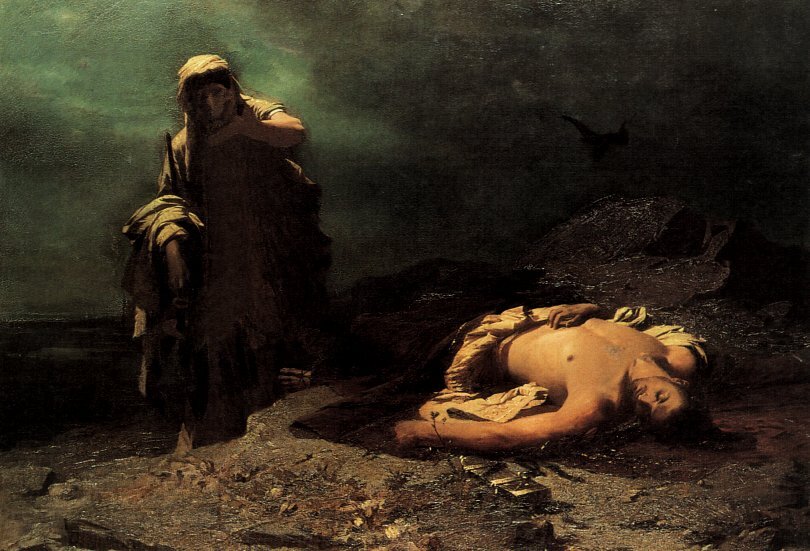
Hegel’s example is Sophocles’ tragedy, Antigone. After Oedipus has relinquished the kingship of Thebes, his two sons, Etiocles and Polynices, become kings in annual rotation. Etiocles is the first to be King of Thebes but refuses to give up the throne. Polynices rebels. He and six foreign princes (“Seven Against Thebes”) march on Thebes. They lose. The brothers fight and kill each other.
Creon, the brother-in-law of Oedipus, assumes the kingship. He orders an honorable burial for Etiocles. But he also orders that Polynices be left to rot. Antigone, the sister of Polynices, demands that Polynices receive a decent burial. Forbidden by Creon to do so, Antigone nonetheless buries Polynices (twice). She is arrested and hangs herself.
- Creon, a leader of the state, has a duty to protect the state from rebellion.
- Antigone, as a sister, has a family duty to provide her brother with a decent burial.
Both cannot be realized. One position must prevail. Tragedy results.
The tone of Plato’s Euthphyro is ironic and jesting, certainly not the solemn atmosphere required for tragedy. And yet something like the story of Antigone is there between the lines.
Antigone | Euthyphro |
|
|
|
|
|
|
|
|
|
|
Plato’s Euthyphro is not high tragedy. Neither Euthyphro nor Socrates seems to care very much about Euthyphro’s father (nor about the day laborer who dies of exposure). The dialogue is filled with Socrates’ witty and ironic comments directed at Euthyphro (who doesn’t get the jokes). The off-stage relatives play the Antigone role. If there is a Socratic tragic element it is Euthyphro’s incorrigible ignorance which, as Socrates has found, is commonplace in Athens.


Leave a Reply